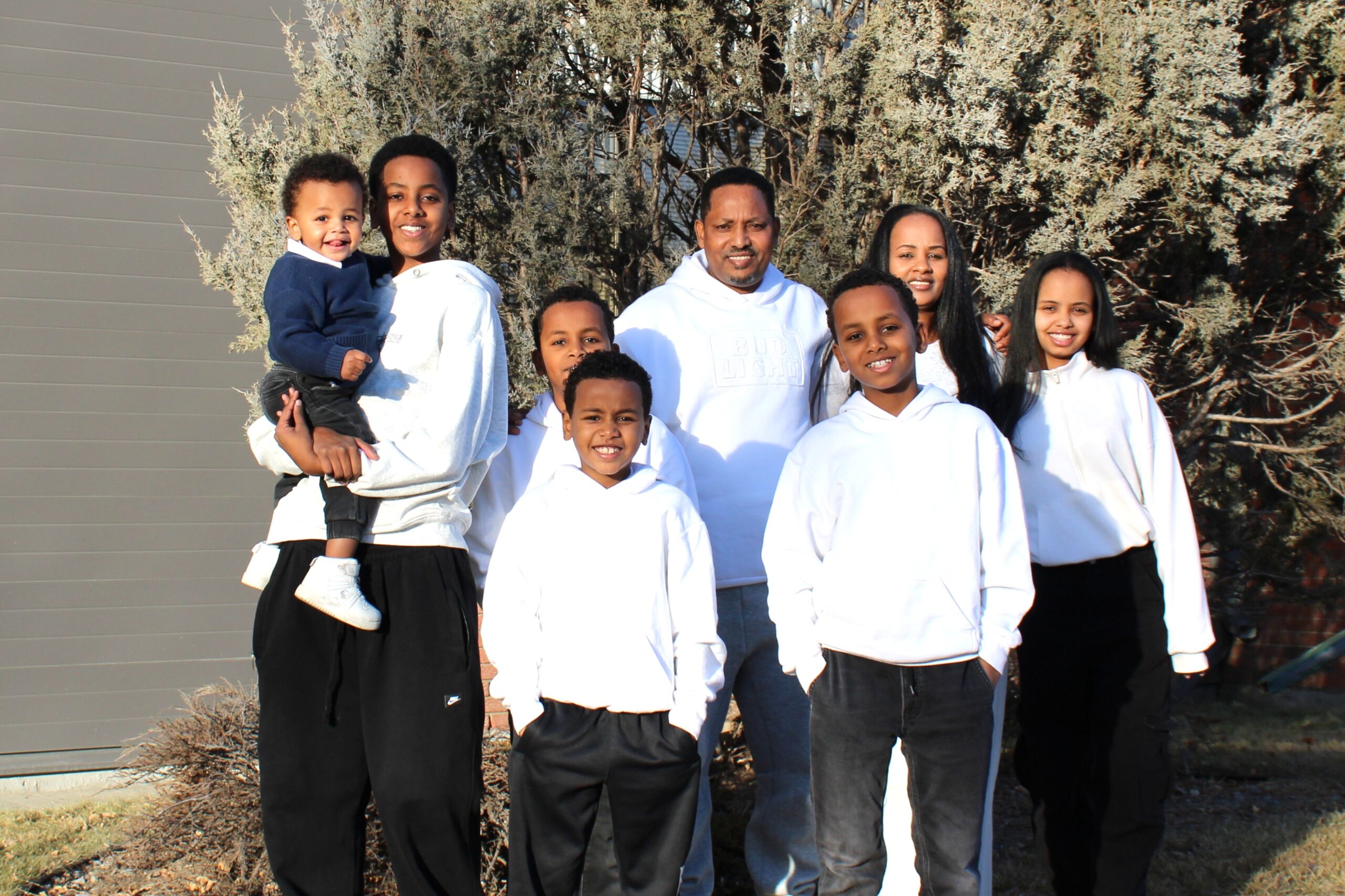
The interview starts before the first question is even finished.
Some hands go up, while others don’t wait. One child jumps in to help finish a sentence, while another leans forward, eager to be heard. Laughter fills the room, layered over half-formed answers and excited interruptions.
Gebremeskel and Asmerat sit just behind it all, smiling as their children take the lead.
Their family includes six children, ranging in age from 15 down to just 1 year old. From the moment they sit down, it is clear that this will be a lively conversation. The kids are animated and confident, quick to share what they like to do together, how they spend their weekends, and what life looks like right now.
Making a small space work
The family currently lives in a two-bedroom apartment in downtown Calgary. For a family of eight, that reality shapes nearly every part of daily life.
When the kids explain how sleeping works, they do it quickly and without much thought, as if it is the most normal thing in the world. They describe bunk beds, shared beds, and siblings sleeping on their own when possible. When extended family visits, the rules shift again and everyone adjusts.
It is clear they are used to making it work. Used to adapting and reshaping routines around a space that has never fit their family.
Laundry happens in the building’s basement, which means frequent trips up and down with heavy loads, carefully timed around shared machines. It is a detail the kids mention casually, but it hints at the constant effort required to manage everyday tasks in a home that leaves little room for flexibility.
Then there is the noise, including fire alarms that go off frequently, sometimes in the middle of the night, along with sirens and people lingering around the building at all hours.
“It’s scary sometimes,” one of the kids says.
For these siblings, unpredictability has become part of their normal life. Interrupted sleep, sudden disruptions, and the feeling that things can change without warning.
The call that changed everything
When the call came to say the family had been approved for a Habitat home, Asmerat was driving. She remembers having to pull over, overwhelmed by the weight of the moment, and unsure how to process it all at once. Relief, gratitude, and disbelief had her in tears on the side of the road.
She didn’t tell the kids right away. Instead, she decided to turn the news into a surprise. That afternoon, she picked them up from school, brought drinks home, and gathered everyone together in the living room. At first, the kids assumed it was something small, perhaps a treat or an announcement, something ordinary.
When she finally told them it was a house, the reaction was immediate. The room filled with excitement as the meaning set in. Even now, as they retell the story, the kids light up.
What they’re most excited about
When the conversation turns to what they are most excited about, the kids answer without hesitation. They talk about having their own beds and their own rooms, and about living in a house that finally feels big enough for their family.
More than one of them mentions storage, explaining how hard it can be to keep track of things right now and how much easier daily life would feel with space to organize.
It’s clear these are not casual wishes. One child describes how hard it can be to study when toys and noise fill every corner, while another talks about always having to search for things before leaving the house. What they describe is the constant effort required to make a small space work for a large family.
Eventually, the conversation turns to what life might look like outdoors. The kids talk about soccer and basketball and about mornings that begin outside with space to play. At their current home, outdoor time is limited and carefully managed. At their new home, they will have their own backyard, parks and playgrounds nearby, and a neighbourhood where being outside feels safe.
What home means
When the question turns to what home means, the energy in the room changes. The answers come more slowly this time. They talk about safety, peace, and about having a place where they can relax.
One child explains that home is somewhere you can trust your surroundings. Another describes it as calm, a place where things feel settled. One of the older kids talks about ownership in their own words, about not paying rent to someone else and about putting effort into something that belongs to their family.
It is not the language of mortgages or equity, but the meaning is clear: stability changes how you see the future.
For Gebremeskel and Asmerat, their affordable Habitat home means safety and predictability for their children. It means housing costs they can plan around and the ability to save and think ahead in a way that has not been possible before.
A home means fewer unknowns and a future their family can count on.
